


Can You Buy a Home With a Low Deposit?
A 20% deposit is common, but it is not the only possible pathway to home ownership. Here is what New Zealand buyers should know about low-deposit home loans.
Can you buy a home with a low deposit?
Yes, it can be possible to buy a home with less than a 20% deposit in New Zealand. The amount you need depends on your circumstances, the lender, the property and the type of lending you qualify for.
For eligible first home buyers, a Kāinga Ora First Home Loan can reduce the required deposit to 5%, subject to the scheme’s eligibility requirements and the participating lender’s own lending criteria.
The important point: having a smaller deposit does not automatically mean you cannot get a home loan. It does mean your application needs to be assessed carefully, because you may be borrowing a larger percentage of the property’s value.

What is considered a low deposit?
A deposit is the amount you contribute towards the purchase price of the property. The rest is generally funded through your home loan.
For a $600,000 home, the difference between deposit levels can be significant:
| Deposit | Deposit amount on a $600,000 home |
|---|---|
| 5% | $30,000 |
| 10% | $60,000 |
| 20% | $120,000 |

Can you buy a house with a 5% deposit?
For eligible first home buyers, the Kāinga Ora First Home Loan provides a pathway to buying with a minimum 5% deposit. The loan is provided by participating lenders and underwritten by Kāinga Ora.
Current eligibility includes requirements around age, residency, first-home-buyer status, income, deposit, owner-occupation and the property. You must also meet the participating lender’s lending criteria.
The current First Home Loan also has a 1.2% Lender’s Mortgage Insurance premium, which can be paid upfront or added to the loan.
What if you have a 10% deposit?
A 10% deposit may also be workable in some circumstances. The Reserve Bank’s LVR rules allow banks to make a limited share of new owner-occupier lending above 80% LVR, although each bank still makes its own lending decision.
This means a buyer with a 10% deposit may have options, but approval is not automatic. Your income, expenses, existing debts, credit history, deposit and the property all matter.
What can you use towards your deposit?
Your deposit does not always have to come entirely from cash savings. Depending on the lender and your circumstances, your deposit may include:
- Personal savings
- Eligible KiwiSaver first-home withdrawal
- Genuine financial gifts from family
- Other acceptable sources of funds, depending on lender requirements

Your deposit is only one part of the application
A lender will look at your overall financial position, not just the amount you have saved.
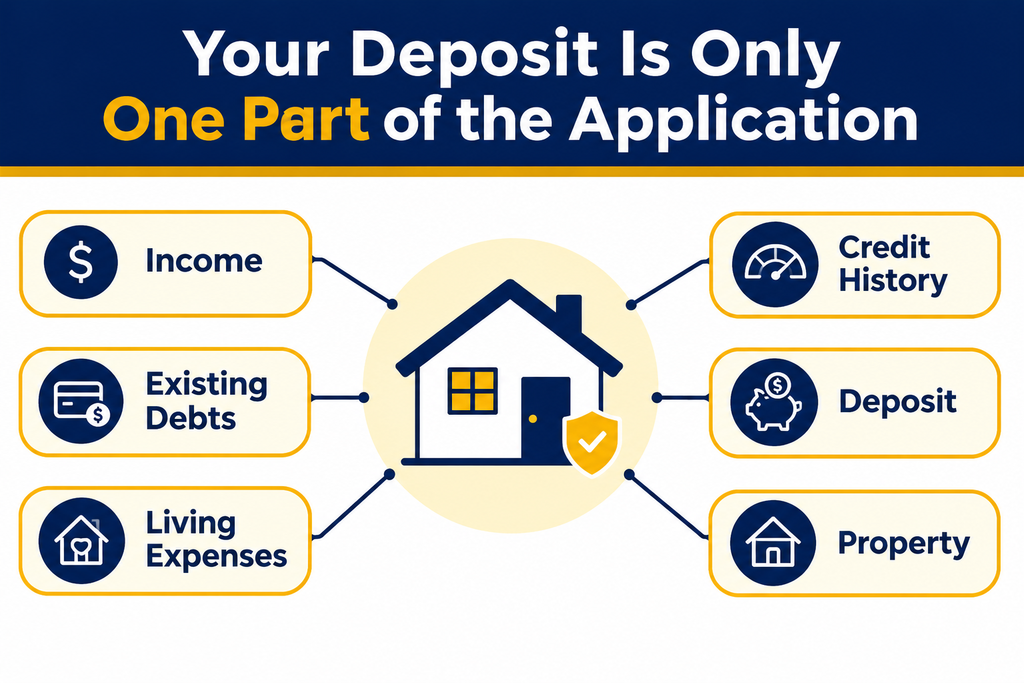
Income
The lender needs to be comfortable that your income is sufficient and reliable enough to support the proposed mortgage alongside your other commitments.
Existing debts
Car finance, personal loans, credit cards, Buy Now Pay Later accounts and other commitments can affect how much you may be able to borrow.
Living expenses
Your regular household spending is part of the affordability assessment. Two households with the same income can have different borrowing capacity because their expenses may differ.
Credit history
Your credit history can form part of the lender’s assessment and may be particularly relevant when you are applying for higher-LVR lending.
The property
The lender also needs to be comfortable with the property being offered as security. Property type, location, condition and other factors can matter.
Why do lenders prefer a larger deposit?
With a larger deposit, you borrow a smaller percentage of the property’s value. This is reflected in the loan-to-value ratio, or LVR.
For example, a 20% deposit means an 80% LVR. A 5% deposit means a 95% LVR.
Reserve Bank LVR restrictions limit the amount of high-LVR lending banks can provide. As of August 2026, up to 25% of new owner-occupier lending can have an LVR above 80%. These are limits on banks’ lending, not a rule saying every individual buyer must have a 20% deposit.
What are the risks of buying with a low deposit?
A low deposit can help you enter the property market sooner, but it is important to understand the trade-offs.
- Larger mortgage: a smaller deposit generally means borrowing more.
- Higher repayments: a larger loan can increase regular repayments and total interest over time.
- Less initial equity: you start with a smaller equity position in the property.
- Potential additional costs or conditions: higher-LVR lending can have specific lender requirements or pricing.
How can you improve your chances?
- Keep your savings consistent and well documented.
- Reduce unnecessary consumer debt where possible.
- Avoid taking on new debt immediately before applying.
- Review your regular spending and understand what repayment you could comfortably manage.
- Prepare your income, bank statements, identification and other supporting documents early.
- Consider getting pre-approval before seriously house hunting.
Should you wait until you have a 20% deposit?
Not necessarily. A larger deposit can reduce the amount you need to borrow, but waiting is not automatically the best choice for every buyer.
The right decision depends on your income, savings, existing commitments, target property, affordability and future plans. The goal should not simply be to get approved; it should be to structure a home loan that remains manageable.
Frequently Asked Questions
1.Can I buy a house with a 5% deposit in New Zealand?
Eligible first home buyers may be able to use a Kāinga Ora First Home Loan with a minimum 5% deposit, subject to eligibility and the participating lender’s criteria.
2.Is a 10% deposit enough to buy a house?
It can be possible in some circumstances. Banks have limited capacity for lending above 80% LVR, and individual applications are assessed against the lender’s criteria.
3.Can KiwiSaver be used towards a first home deposit?
If you meet the relevant requirements, you may be able to withdraw eligible KiwiSaver savings to help purchase your first home.
4.Can family help with my deposit?
Yes, a genuine gift from a relative may be accepted by some lenders, subject to their requirements and documentation.
5.Is a low-deposit mortgage more expensive?
It can involve a larger loan, higher repayments and potentially additional lender costs or conditions. The exact impact depends on the lender and loan structure.
6.Can I buy an investment property with a low deposit?
Investment-property lending generally has different requirements from owner-occupied lending. Deposit and LVR requirements can be higher, so your circumstances and the lender’s current criteria need to be assessed separately.
7.Have a low deposit and want to know what may be possible?
Before you start making offers, it can help to understand your borrowing position and the home loan options that may fit your circumstances.

