

Your deposit helps you buy the home. Your financial buffer can help you handle the unexpected costs that come after the keys.
Buying a home is exciting, but getting the keys is not the end of your financial journey. Once you become a homeowner, the unexpected costs that were once your landlord’s problem can suddenly become yours.
A leaking hot-water cylinder, urgent plumbing work, an appliance that stops working, an insurance excess, or an unexpected reduction in income can all put pressure on your household budget.
That is why your deposit should not necessarily be the only savings goal when preparing to buy a home.
How much money should you still have available after you buy?
There is no single emergency-fund amount that is right for every New Zealand home buyer. Understanding your likely expenses, commitments and circumstances can help you decide on a sensible buffer.
What Is an Emergency Fund?
An emergency fund is money you keep available for unexpected or urgent expenses. It is different from money deliberately set aside for your deposit, solicitor, moving costs, furniture or planned renovations.
- Urgent home repairs
- Car repairs
- Insurance excesses
- Unexpected medical or dental expenses
- Reduced hours or temporary loss of income
- An essential appliance needing replacement
The purpose is simple: to give your household some breathing room when something does not go according to plan.

Why Is an Emergency Fund Particularly Important for Homeowners?
When you rent, some major property-related expenses are generally the responsibility of the property owner. Once you own the home, that changes.
Imagine you have recently moved into your first home and the hot-water cylinder unexpectedly needs replacing. The mortgage still needs to be paid. So do the rates, insurance, groceries, power, transport and other household expenses.
Having accessible savings can mean you are better prepared to deal with the expense without immediately needing to rely on another form of credit.

Should You Put Every Dollar Into Your Deposit?
Imagine you have saved $100,000. Putting the entire amount toward the property may mean a bigger deposit and a smaller mortgage—but consider what your finances look like immediately after settlement.
OPTION A$100,000toward the purchase$0 emergency savings
OPTION B$90,000toward the purchase$10,000 cash buffer
Option B is not automatically better. Keeping $10,000 aside also means putting $10,000 less toward the property, which can affect the amount you need to borrow and potentially your LVR or lending options. The key point is that the deposit should not be considered in isolation.
So, How Much Should You Keep?
You will sometimes hear general rules such as keeping three to six months of essential expenses as an emergency fund. That can be a useful starting point, but it should not be treated as compulsory for every buyer.
If essential expenses are $4,000 per month, three months is about $12,000 and six months is about $24,000. If expenses are $7,000 per month, those figures become $21,000 and $42,000.
Rather than starting with an arbitrary number, understand how much it actually costs to keep your household running each month.
Calculate Your Essential Monthly Expenses
| Essential commitment | Monthly amount |
|---|---|
| Mortgage repayment | $_____ |
| Rates | $_____ |
| Home insurance | $_____ |
| Power / utilities | $_____ |
| Groceries | $_____ |
| Transport | $_____ |
| Vehicle / other loan repayments | $_____ |
| Childcare | $_____ |
| Total | $_____ |
If essential expenses after buying are approximately $5,000 per month, one month is $5,000, three months is $15,000 and six months is $30,000. You can then consider what level of buffer is realistic for your household.
Your Emergency Fund Depends on More Than Your Expenses
Income stability
A household with stable salaries may view its buffer differently from someone whose income is seasonal, commission-based, contract-based or self-employed.
One income or two?
A household relying on one income may face a different risk if that income temporarily stops. Two incomes can change the picture, although it does not remove the need to plan.
Dependants
Childcare, schooling, transport, food and other commitments can increase the amount needed to keep a household operating.
Other debts
Car finance, personal loans, student loan obligations, credit cards and other commitments may continue even when something unexpected happens.
Don’t Forget the Costs of Becoming a Homeowner
Buying a home can involve costs beyond the deposit, including legal fees, property reports, valuation costs, moving expenses and insurance. Then there are costs after moving in—appliances, curtains, furniture, repairs and other household needs.
Individually these may not seem enormous. Together they can quickly reduce the savings you have left.
Emergency Fund vs “New House” Fund
It can help to think of these as two different buckets. A new house fund is for predictable expenses such as moving, furniture, appliances and planned improvements. An emergency fund remains untouched unless something genuinely unexpected happens.
If you have $10,000 in savings but already plan to spend $8,000 on furniture and moving costs, your real emergency buffer is closer to $2,000, not $10,000.
What If Keeping an Emergency Fund Reduces Your Deposit?
Suppose a first-home buyer is considering a $700,000 property and has $80,000 in total available savings. Keeping $10,000 aside leaves $70,000 toward the purchase rather than $80,000.
That difference can affect the amount borrowed and resulting LVR, which may influence lender options and lending criteria. This is why simply saying “always keep $10,000 aside” would not be appropriate. Run the numbers before deciding.
What About Using a Credit Card as Your Emergency Fund?
A credit card can provide access to money, but it is not the same as having savings. Using credit for an emergency creates new debt that needs to be repaid, and interest may apply. Credit card limits can also be relevant when a lender assesses a home loan application.
Where Should an Emergency Fund Be Kept?
An emergency fund generally needs to be accessible. Some people choose a separate savings account or another readily accessible cash facility. Keeping it separate from everyday spending can also make it less tempting to use for non-emergencies.
What If You Can’t Have a Perfect Emergency Fund Before Buying?
Do not assume you must have a perfectly funded six-month emergency account before considering a home. For many first-home buyers, simultaneously building a deposit, covering purchase costs and retaining a large emergency fund may be difficult.
Ask instead:
How much cash will I have left after settlement?
What are my essential monthly expenses?
How secure is my household income?
What debts will continue?
What unexpected expenses could I handle?
How quickly could I rebuild my savings?
Don’t Become “House Rich and Cash Poor”
Imagine finally buying the property you wanted but having almost no money available afterwards. On paper, you own a valuable asset. In everyday life, however, one unexpected $2,000 or $3,000 expense could create immediate pressure.
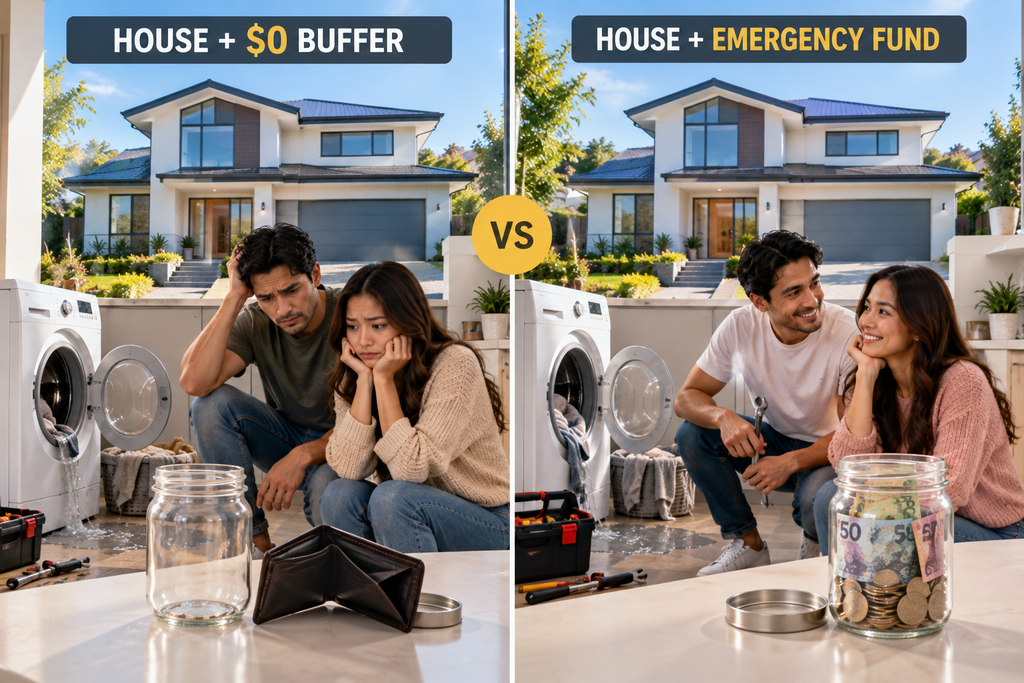
A slightly larger deposit can be valuable, but so can having enough breathing room to transition into home ownership. The goal is not simply to get through settlement day—it is to be prepared for the months and years that follow it.
Build the Emergency Fund Into Your Home-Buying Plan
Total savings
− Deposit contribution
− Legal and purchasing costs
− Moving costs
− Planned immediate expenses
= Savings remaining after settlement
Then compare that amount with your expected monthly essential expenses. That gives you a clearer picture of your position after purchasing.

How a Mortgage Adviser Can Help
When planning a home purchase, the conversation should not stop at “How much can I borrow?” Another useful question is “What will my finances look like after I buy?”
At Mortgage Advisors, we can review your income, deposit, existing debts and proposed lending and help you understand how different borrowing and deposit scenarios may affect your home loan position.
For example, we can compare what the lending might look like if you put more savings toward the property versus retaining part of your savings as a financial buffer.
Frequently Asked Questions
How much emergency savings should I have before buying a house?
There is no single amount suitable for every buyer. Several months of essential expenses can be a useful reference point, but the appropriate amount depends on household costs, income stability, debts, dependants and other circumstances.
Is three months of expenses enough?
It may suit some households and be insufficient for others. Calculate your essential expenses and consider the risks relevant to your household.
Should I use all my savings for my house deposit?
Not automatically. A larger deposit can reduce borrowing, but using all available cash may leave little buffer after settlement. The effect on your deposit, LVR and lending position should be considered.
Should first-home buyers have an emergency fund?
Accessible savings after purchasing can be useful because unexpected expenses can arise once you own a home. The realistic amount depends on your circumstances.
Plan Beyond the Deposit
Buying the home is one milestone. Being financially prepared for what comes afterwards matters too. Talk to Mortgage Advisors about how your deposit, proposed lending and remaining buffer may work together.


