


Buying a home involves more than finding a property you love. You also need to understand how you will pay for it, what your loan will cost and how the repayments will fit into everyday life.
Mortgage language can make this feel complicated. Words like principal, LVR and refinancing become easier to understand when you connect them to real numbers and decisions.
This mortgage guide for beginners in NZ explains the essentials, from saving a deposit and applying for pre-approval to choosing a loan structure and reviewing it after you move in.
1. What is a mortgage?
A home loan is money borrowed to buy property. The mortgage is the legal security the lender takes over that property. In everyday conversation, people often use “mortgage” to mean the loan itself.
You agree to repay the amount borrowed, plus interest and any applicable fees, under the loan agreement. Because the property secures the debt, serious repayment problems can put your home at risk.
Before signing, understand the repayments, the loan conditions and your responsibilities. Your lawyer handles the legal documentation, while your mortgage adviser can explain the lending options.
2. How do home loans work?
Most buyers contribute a deposit and borrow the balance of the purchase price.
For example, an $800,000 home purchased with a $160,000 deposit would require a $640,000 loan, assuming purchase costs are paid separately.
The lender assesses your finances and the property before agreeing to lend. Once the purchase settles, you make regular repayments under your chosen loan structure.
Over time, repaying the loan builds equity: the difference between the property’s value and the debt secured against it. Property values can fall as well as rise, so equity does not increase automatically.
3. Understanding principal and interest
What is principal?
Principal is the amount you owe. If your loan starts at $640,000, that is your initial principal.
What is interest?
Interest is the charge for borrowing. On a standard principal-and-interest loan, each repayment covers interest and reduces part of the principal.
Early in a typical table loan, more of each payment goes towards interest. As the balance decreases, more goes towards principal, assuming the rate and repayment arrangement remain unchanged.
An interest-only arrangement covers interest for an agreed period without reducing principal through scheduled payments. When that period ends, principal-and-interest repayments can increase substantially because the principal must be repaid over the remaining term.

4. How mortgage interest rates affect your budget
An interest rate is usually quoted as an annual percentage. Even a small difference can materially change repayments on a large loan.
Consider this illustrative $600,000 principal-and-interest loan over 30 years:
| Annual interest rate | Approximate monthly repayment |
|---|---|
| 5% | $3,221 |
| 6% | $3,597 |
| 7% | $3,992 |
These are calculated examples, not current offers. They assume monthly payments, a constant rate for the full term and no fees. Actual lender calculations may differ.
Budget for a possible rate increase, rather than relying only on today’s repayment. A manageable mortgage leaves room for other bills and unexpected expenses.
5. Fixed vs variable mortgages
In New Zealand, variable rates are commonly called floating rates.
| Feature | Fixed rate | Floating rate |
|---|---|---|
| Interest rate | Agreed for a specified period | Can change |
| Budgeting | Greater certainty during the fixed period | Payments may change with the rate |
| Extra payments | Subject to lender allowances and possible costs | Usually more flexible; check terms |
| Early changes | Break costs may apply | Generally easier to change |
A fixed rate may suit someone who values predictable repayments. A floating portion may suit someone who expects to make extra payments or needs flexibility.
You can also split the loan into portions, using different fixed periods or a mixture of fixed and floating. This spreads renewal dates but adds decisions to manage. The appropriate split depends on your cash flow and plans.

6. Choosing your loan term
The loan term is the overall repayment period, often 25 or 30 years. The fixed-rate period is the shorter period during which an agreed interest rate applies.
A 30-year mortgage fixed for two years still has a 30-year repayment schedule. At the end of those two years, you need to decide what rate arrangement comes next.
A longer term generally lowers scheduled repayments but increases total interest if other assumptions stay the same. A shorter term requires higher repayments but can reduce the lifetime borrowing cost.
Choose a repayment commitment you can sustain, then consider extra payments when your budget allows.
7. How much deposit do you need?
A deposit is your contribution towards buying the property. A larger deposit reduces the loan required and may improve access to lending options.
For an owner-occupied home, 20% is an important benchmark, but it is not a universal legal minimum. Some lower-deposit lending is available, subject to bank capacity, eligibility and assessment.
Plan separately for legal fees, inspections, any required valuation, moving costs and a cash buffer. Putting every available dollar into the purchase can leave you exposed to the first unexpected bill.
Ask what evidence is needed for savings, gifted funds or other deposit sources. Do this early so your application reflects money you can actually access.

8. What is LVR?
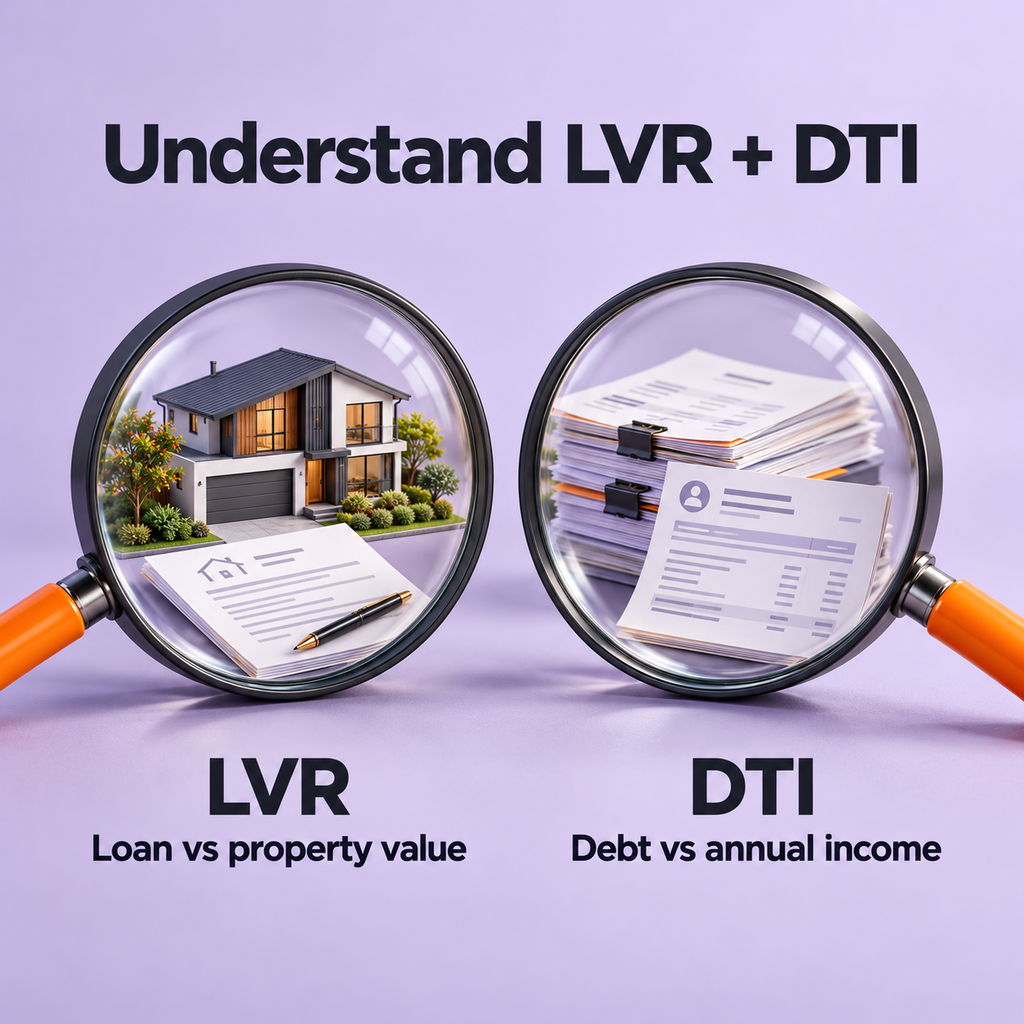
LVR means loan-to-value ratio. It compares the loan secured against a property with the property value accepted by the lender.
LVR = loan amount ÷ property value × 100
A $640,000 loan against an $800,000 property has an LVR of 80%.
Under the current Reserve Bank settings, banks may allocate up to 25% of new owner-occupier lending above 80% LVR. For investors, up to 10% of new lending may be above 70% LVR. Exemptions apply to some lending. These limits govern banks’ lending portfolios and do not promise approval to an individual buyer.
The lender still assesses affordability, credit history and the property. Its accepted valuation may differ from the purchase price.
9. What is DTI?
DTI means debt-to-income ratio. It compares total debt, including the proposed borrowing, with annual gross income.
DTI = total debt ÷ annual gross income
For example, total debt of $720,000 divided by gross annual income of $120,000 produces a DTI of 6.
Current Reserve Bank rules allow banks to allocate up to 20% of new owner-occupier lending above a DTI of 6, and up to 20% of investor lending above 7. Certain loans are exempt.
DTI is different from affordability. Meeting a DTI threshold does not mean the repayments suit your budget or that a bank will approve the loan. Existing debts, including credit-card limits in the regulatory calculation, can affect the result.
10. Getting mortgage pre-approval
Pre-approval is a lender’s conditional indication of how much it may lend after assessing your circumstances. It helps you set a property-search budget.
Read the conditions and expiry date carefully. The lender still needs to approve the specific property, and changes to your income, debts or circumstances may affect the decision.
Before making an unconditional commitment, confirm that your finance requirements are satisfied and obtain legal advice. This matters particularly at auction, where a successful purchase is generally unconditional.
Treat the approved amount as a ceiling for your search, then choose a comfortable personal budget within it.

1. Preparing your mortgage application
A complete application helps the lender understand your position and reduces avoidable follow-up questions.
You will typically need identification, proof of deposit, income evidence, bank statements, information about expenses and existing debts, and property details when available. Self-employed applicants may need financial statements and additional supporting records. Exact requirements vary by lender.
Explain irregular income and unusual transactions clearly. Include all commitments so the affordability assessment is accurate.
Related reading: How to Improve Your Financial Position Before Buying a Home.
From application to settlement
The usual journey is assessment, conditional approval, approval of the property and remaining conditions, then loan documentation and settlement. Your adviser coordinates lending requirements; your lawyer manages the legal purchase and mortgage process.
12. Managing mortgage repayments
Choose a repayment frequency that fits your income and arrange payments so sufficient funds are available when they fall due.
Include rates, insurance, maintenance and any body corporate fees in your household budget. The mortgage payment is only one part of owning a home.
Extra repayments reduce principal and can lower future interest, subject to loan conditions. Paying half a monthly payment every fortnight results in 26 half-payments a year, equivalent to 13 monthly payments. Simply changing payment frequency does not guarantee that increase; check the actual amounts.
Related reading: How to Build an Emergency Fund While Paying a Mortgage.
13. Understanding refinancing
Refinancing means replacing an existing mortgage with a new loan. It may involve staying with the same lender or moving elsewhere. Refixing usually means agreeing to another fixed-rate period on the existing loan.
Compare the proposed benefit with break costs, legal fees, valuations, discharge charges and any repayment of a previous cash incentive. A new lender also needs to approve your application. [8]
Compare options over the same remaining loan term. Extending the term may lower repayments while increasing total interest, even if the new interest rate is lower.
Related reading: Should You Invest or Pay Down Your Mortgage?
14. Making early repayments
Early repayments can include increasing regular payments or making a lump-sum payment.
Before paying extra on a fixed loan, ask about the fee-free allowance and obtain a break-cost quote if necessary. Limits differ between products and lenders, so avoid assuming someone else’s allowance applies to you.
If you expect a bonus or plan to sell soon, discuss that before fixing. Loan flexibility is easier to plan for in advance.
Also retain enough accessible cash for emergencies. Reducing debt is helpful, but a future top-up requires approval; money paid into a standard loan is not necessarily available to withdraw.
15. Why mortgage reviews matter
A mortgage chosen today may need adjusting as your circumstances change. Consider a review before each fixed period expires and whenever your income, household costs or property plans change.
Check the remaining balance, repayment amount, rate-expiry dates, fees and flexibility. Ask whether increased income or reduced expenses could support faster repayment without straining your budget.
Keep a simple record of each loan portion and its renewal date. Planning ahead gives you time to compare options and understand costs before making a decision.

Frequently asked questions
Do I always need a 20% deposit?
No. Lower-deposit lending can be available, but approval depends on lender assessment, available lending capacity and applicable rules. A smaller deposit means borrowing more for the same property price.Is fixed or floating better for a beginner?
Fixed offers rate certainty for an agreed period; floating generally offers flexibility. Consider your budget, likely extra repayments and future plans rather than choosing solely on the headline rate.Does pre-approval guarantee the mortgage?
No. It is conditional. The lender must approve the property and outstanding requirements, and you must remain eligible under the approval conditions.Can I pay my mortgage off early?
Usually, but fees or limits may apply, especially during a fixed-rate period. Confirm the cost with your lender before making a payment or changing the loan.How often should I review my home loan?
A practical approach is before each fixed period ends and after a significant financial or life change. A review does not automatically mean switching lenders.
Speak with a mortgage broker about your next step
Whether you are saving a deposit, ready for pre-approval or reviewing an existing loan, understanding the numbers makes the next decision easier.
Speak with Mortgage Advisors about your circumstances, borrowing options and loan structure. Bring details of your income, expenses, debts and deposit so the conversation can focus on a realistic plan.

