


Fixed vs Floating Mortgage: Which Mortgage Is Better for First Home Buyers?
A practical guide to choosing between fixed and floating/variable home loans — including when a split mortgage could make sense.
The short answer: fixed mortgages priorities repayment certainty, while floating/variable mortgages priorities flexibility. For some buyers, splitting the loan can balance both.
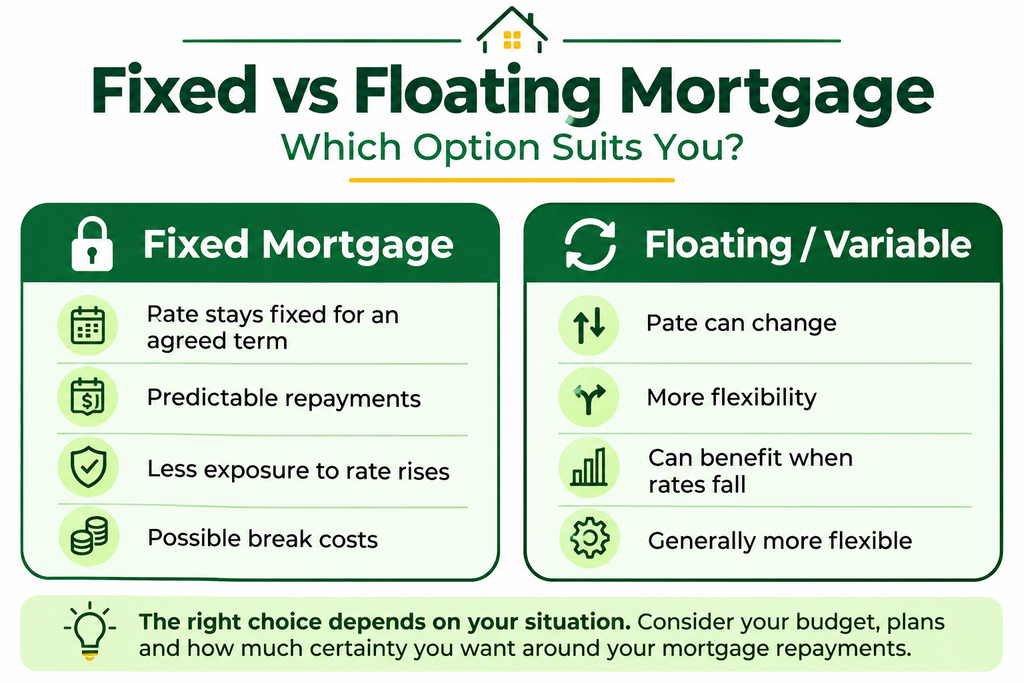
Choosing between a fixed and floating mortgage can feel like choosing between certainty and opportunity. For first home buyers, the decision matters because your mortgage is likely to be one of the largest financial commitments you will make. The right structure can make your repayments easier to manage, while the wrong one can leave your budget under pressure when interest rates or your circumstances change.
The good news is that there is no universal “best” mortgage. A fixed mortgage can provide valuable repayment certainty, while a floating or variable mortgage can give you more flexibility and the potential to benefit when rates fall. For some borrowers, a combination of the two — often called a split mortgage — can provide a useful middle ground.
In this guide, we explain the differences in plain English, the advantages and disadvantages of each option, and the questions first home buyers should ask before choosing a mortgage structure.

What is a fixed mortgage?
A fixed mortgage means the interest rate on the fixed portion of your home loan stays the same for an agreed period. Depending on the lender and product, you may be able to choose from different fixed terms.
The main attraction is predictability. If your rate is fixed, your scheduled principal-and-interest repayment is generally easier to forecast during that fixed period. That can be especially valuable when you are buying your first home and still working out your ongoing costs such as rates, insurance, maintenance, utilities and childcare.
Benefits of a fixed mortgage
- Predictable repayments: you can budget with greater confidence while the rate is fixed.
- Protection from rising rates: your fixed rate does not move up simply because market rates rise.
- Budgeting certainty: a known repayment can make it easier to plan your household cash flow.
- Peace of mind: you have less exposure to short-term interest-rate movements.
Potential drawbacks of fixing
Fixed loans can be less flexible. Depending on your lender and loan terms, making large additional repayments, refinancing, selling the property or changing the loan before the fixed period ends may involve restrictions or break costs. It is important to understand these conditions before you fix.
Another consideration is that a fixed rate can become less attractive if market rates fall significantly during your fixed term. You gain certainty, but you may not immediately benefit from lower rates elsewhere in the market.

What is a floating or variable mortgage?
A floating or variable mortgage has an interest rate that can change over time. The rate may move in response to changes in market conditions, lender pricing and broader interest-rate settings.
That means your repayments can rise or fall. If rates decrease, a floating borrower may benefit sooner than someone locked into a higher fixed rate. If rates rise, however, the same flexibility can work against you.
Benefits of a floating or variable mortgage
- More flexibility: variable structures can make it easier to make extra repayments or change your loan strategy, depending on the lender.
- Potential benefit from falling rates: your rate can reduce when your lender passes on lower pricing.
- Useful for changing circumstances: flexibility may matter if you expect to sell, refinance or make substantial repayments.
- Can work well with flexible features: some variable products offer features such as offset or revolving-credit arrangements.
Potential drawbacks of floating
The biggest issue is uncertainty. If your rate increases, your repayment may increase too. For a first home buyer with a tight budget, even a relatively small change can affect how much money is available for savings, bills and lifestyle expenses.
A variable rate therefore tends to suit borrowers who have enough financial breathing room to cope with repayment changes and who value flexibility more highly than certainty.

Fixed vs floating: the key differences
The simplest way to think about the choice is this: fixed is primarily about certainty; floating is primarily about flexibility. Neither automatically costs less over the life of a mortgage because the outcome depends on future interest rates, the length of your fixed term, your loan structure and how you use the features available to you.
| Feature | Fixed | Floating / Variable |
|---|---|---|
| Rate | Stays fixed for the agreed term | Can change over time |
| Repayment certainty | Higher during the fixed period | Lower |
| Exposure to rate rises | Lower during the fixed period | Higher |
| Benefit if rates fall | Usually delayed until refixing | Potentially earlier |
| Flexibility | Can be more restricted | Generally more flexible |
| Best suited to | Borrowers prioritising certainty | Borrowers prioritising flexibility |
So, which mortgage is better for first home buyers?
For many first home buyers, the answer depends less on predicting interest rates and more on understanding your own budget and plans.
If a rise in repayments would put your household under significant pressure, the certainty of fixing some or all of your mortgage may be valuable. If you have a strong cash buffer, expect your circumstances to change, or want to make larger extra repayments, a floating portion may provide useful flexibility.
Rather than asking “Which rate will be cheapest?”, a better question is: “Which mortgage structure gives me a repayment I can comfortably manage while still allowing enough flexibility for my plans?”
Could a split mortgage be the best of both worlds?
A split mortgage divides your home loan into separate portions. For example, a borrower might fix the majority of the mortgage and leave a smaller portion floating.
Imagine a $500,000 mortgage split into $400,000 fixed and $100,000 floating. The fixed portion provides greater repayment certainty on most of the loan, while the floating portion can provide flexibility for extra repayments or changing circumstances.
This approach does not remove interest-rate risk, and it is not automatically better than having one loan structure. But it can help balance two competing priorities: certainty and flexibility.
Example: An $500,000 mortgage split 80/20 would have $400,000 fixed and $100,000 floating. The exact rates, repayments, fees and suitability would depend on the lender and your circumstances.

Don’t try to predict interest rates
It is tempting to choose a mortgage by trying to guess where rates will be six, twelve or twenty-four months from now. But even professional forecasters can be wrong. A more robust approach is to choose a structure that fits your risk tolerance and financial plans.
Think about your income stability, emergency savings, expected expenses and the likelihood of making extra repayments. Then consider how much certainty you need versus how much flexibility you value.
What first home buyers should compare beyond the rate
The interest rate is important, but it is not the only thing that determines whether a mortgage is suitable. Compare the whole loan package, including fees, repayment rules, fixed-term conditions, break costs, offset or revolving-credit features, early repayment options and what happens when a fixed term expires.
It is also worth checking whether the lender’s lending criteria fit your situation. Your deposit, income, existing debts, spending patterns and other commitments can all influence the loan amount and structure available to you.
Final thoughts
Fixed vs floating is not really a contest between a “good” option and a “bad” option. It is a decision about how you want to manage risk.
A fixed mortgage can give you more certainty and protection from rising rates during the fixed period. A floating or variable mortgage can give you more flexibility and the opportunity to benefit if rates fall. A split mortgage can combine the two by placing different portions of the loan on different structures.
For a first home buyer, the best choice is usually the one that fits your budget, your plans and your comfort with changing repayments. Before committing, compare the full costs and conditions and get advice based on your individual circumstances.

frequently asked questions
Don’t try to predict interest rates
It is tempting to choose a mortgage by trying to guess where rates will be six, twelve or twenty-four months from now. But even professional forecasters can be wrong. A more robust approach is to choose a structure that fits your risk tolerance and financial plans.
Think about your income stability, emergency savings, expected expenses and the likelihood of making extra repayments. Then consider how much certainty you need versus how much flexibility you value.
What first home buyers should compare beyond the rate
The interest rate is important, but it is not the only thing that determines whether a mortgage is suitable. Compare the whole loan package, including fees, repayment rules, fixed-term conditions, break costs, offset or revolving-credit features, early repayment options and what happens when a fixed term expires.
It is also worth checking whether the lender’s lending criteria fit your situation. Your deposit, income, existing debts, spending patterns and other commitments can all influence the loan amount and structure available to you.
Final thoughts
Fixed vs floating is not really a contest between a “good” option and a “bad” option. It is a decision about how you want to manage risk.
A fixed mortgage can give you more certainty and protection from rising rates during the fixed period. A floating or variable mortgage can give you more flexibility and the opportunity to benefit if rates fall. A split mortgage can combine the two by placing different portions of the loan on different structures.
For a first home buyer, the best choice is usually the one that fits your budget, your plans and your comfort with changing repayments. Before committing, compare the full costs and conditions and get advice based on your individual circumstances.
Ready to choose the right mortgage structure?
You do not have to work it out alone. A mortgage broker can compare loan structures, explain the trade-offs and help you decide how much of your mortgage you may want fixed or floating.

