


The right fixed term is not simply about today’s lowest rate. It is about balancing certainty, flexibility and what may change in your life.
Choosing a fixed mortgage rate is only half the decision. The next question is often harder: how long should you fix it for?
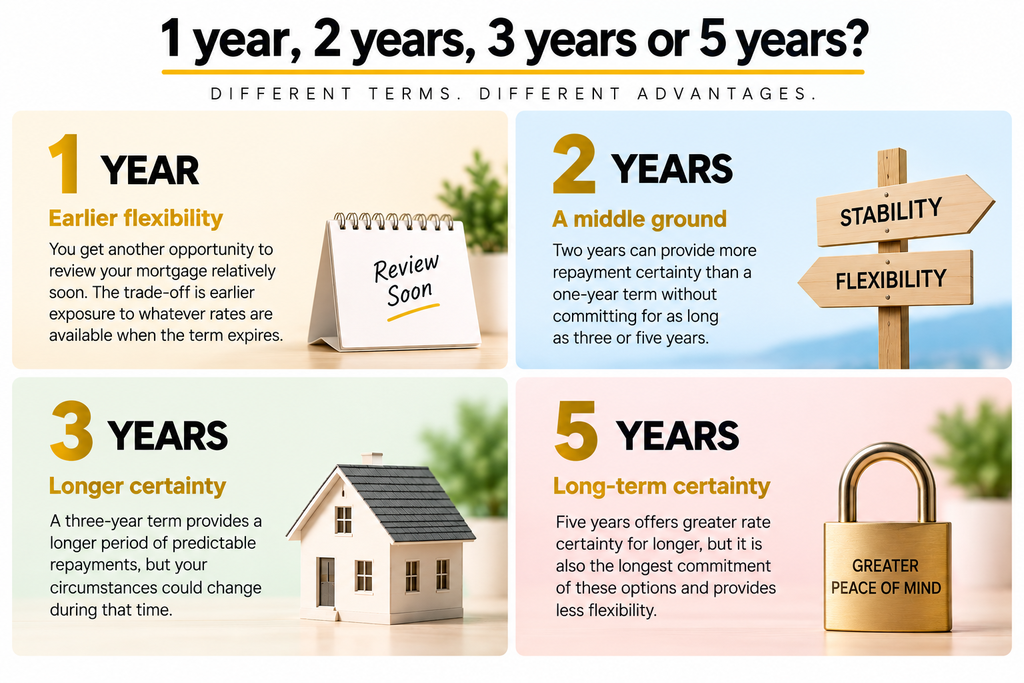
One year? Two years? Three years? Or five years? There is no single fixed term that suits every New Zealand homeowner. A shorter term can give you an earlier opportunity to review your mortgage, while a longer term can provide greater repayment certainty.
What does a fixed mortgage term mean?
When you fix your home loan, the interest rate applying to that portion of the mortgage is generally fixed for an agreed period. Common options include 1, 2, 3 and 5 years. When the term ends, you normally review the rates and structures available at that time.

Your mortgage may last 20 or 30 years. Your fixed-interest period does not. You may refix several times over the life of the loan.
Think about where life could be when your term ends
Your fixed term is not only an interest-rate decision. Your income, family, career and property plans may look different by the time it expires.
You could sell the property, move home, receive a significant increase in income, want to refinance, make a large lump-sum repayment or restructure your lending. A longer fixed term should therefore be considered alongside your future plans as well as the rate available today.

Don’t choose only because one rate is lowest today
Suppose the one-year rate is lower than the three-year rate. It can be tempting to conclude that one year is automatically the better option. But today’s advertised rate tells you only part of the story because you do not know what rates will be available when that term expires.
Likewise, choosing a longer term because you expect rates to rise means accepting the possibility that rates could instead fall while you remain fixed. The decision is partly about which type of uncertainty you are more comfortable managing.
What if rates fall after you fix?
If market rates fall during your fixed period, you generally cannot simply move the existing fixed loan onto a lower rate without considering your lender’s conditions and potential costs. Ask yourself: would I still be comfortable with this term if lower rates became available next year?
What if rates rise after you fix?
If market rates rise, the rate applying to your fixed portion generally remains unchanged until the fixed period expires. For borrowers who value predictable repayments, that certainty can be important. Fixing does not have to be about trying to “beat” the market; it can be about managing household cash-flow risk.

You don’t necessarily have to choose just one term
Depending on the lender and loan structure, a mortgage may be split into different portions. For example, a $600,000 mortgage could potentially be divided into $200,000 fixed for one year, $200,000 for two years and $200,000 for three years.
Why split? Different portions come up for review at different times rather than the entire mortgage refixing on one date. Splitting does not guarantee lower interest costs and can make the mortgage more complicated to manage.
Before choosing your fixed term, ask yourself
- How important is repayment certainty to my household?
- Could I comfortably manage higher repayments when the term ends?
- Am I likely to sell or move during the fixed period?
- Could I want to refinance or restructure?
- Am I expecting a significant change in income?
- Do I expect to make large extra repayments?
- Would splitting the mortgage across different terms suit me?
- How much flexibility do I want?
So, should you fix for 1, 2, 3 or 5 years?
Think of the options as a spectrum. A shorter term generally gives you an earlier opportunity to review your mortgage, while a longer term generally gives you more certainty for longer.
There is no universal winner. The goal is to choose a mortgage structure that works with your financial position, future plans and tolerance for uncertainty rather than simply chasing whichever fixed rate is lowest today.

Frequently Asked Questions
Is a 1-year or 2-year fixed mortgage better?
Neither is automatically better. One year gives you an earlier review point, while two years provides certainty for longer. Your plans, budget and the rates available at the time all matter.
Is fixing for five years risky?
A five-year term provides substantial repayment certainty, but it also means committing for a long period. Consider the possibility that your circumstances or market rates could change.
Can I break a fixed mortgage early?
Potentially, but lender terms apply and costs may be involved. Check the conditions of your specific loan before changing, refinancing or repaying fixed lending early.
Can I split my mortgage between different fixed terms?
Depending on the lender and loan structure, yes. Splitting can spread refixing dates, although it also creates multiple loan portions to manage.
Not sure which fixed term fits your plans?
Mortgage Advisors can help you compare home-loan options and consider a structure that suits your circumstances, budget and future plans.

