


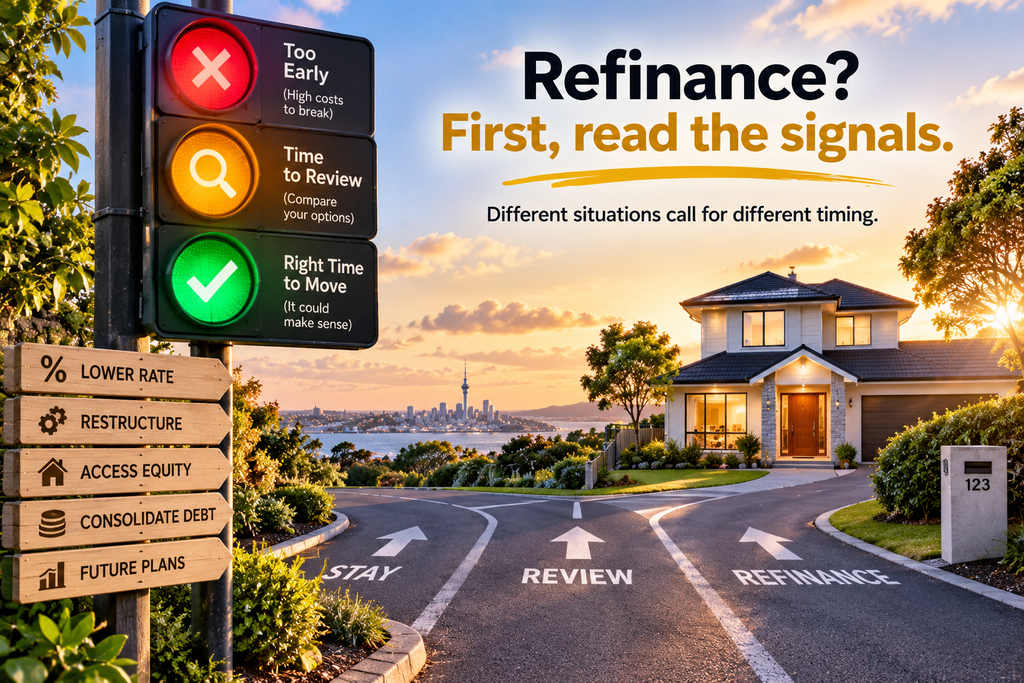
Refinancing your mortgage can potentially help you secure a more suitable interest rate, change your loan structure or adapt your lending to a new stage of life. But refinancing is not only about whether you should do it. Timing matters too.
Moving too early could mean paying break costs or giving up a favourable fixed rate. Waiting without reviewing your options could mean continuing with a mortgage that no longer suits your circumstances.
For New Zealand homeowners, there is no single perfect date to refinance. Instead, there are several financial and life signals that can tell you it may be worth reviewing your mortgage.
What Does “The Right Time” to Refinance Actually Mean?
The right time is not necessarily the day mortgage rates reach their lowest point. Future rates are uncertain, and a refinancing decision involves much more than the advertised rate.
A better question is:
Has something changed that makes your current mortgage worth reviewing?
That change might come from the mortgage market, your property, your income, your debts or your future plans. The important part is comparing the potential benefit of a new arrangement with the costs and practical consequences of making the change.
1. Your Fixed Mortgage Rate Is Approaching Expiry
This is one of the most natural times to review your mortgage. When a fixed-rate period ends, you usually need to decide what happens next with that portion of your lending.
It can be tempting to simply choose another fixed term offered by your existing lender. But before doing that, use the opportunity to look at the bigger picture. Is your current lender still suitable? Does your mortgage structure still work for you? Would splitting the mortgage differently suit your cash flow? Have your circumstances changed since you last fixed?
Starting the review before the fixed term expires can give you time to investigate your options rather than making a rushed decision.
2. Interest Rates Have Changed Significantly
If current mortgage rates look materially different from the rate attached to your existing lending, it is understandable to wonder whether refinancing could reduce your costs.
But a lower advertised rate does not automatically make refinancing worthwhile. If you are still within a fixed period, there may be break costs. Legal expenses, lender fees and cashback conditions can also affect the calculation.
Potential benefit of changing − cost of changing = the comparison that matters.
3. You Have Built More Equity in Your Home
Your position as a borrower can change as you repay your mortgage. Your property’s value may also change over time. Together, these factors affect the equity you hold in your home.

In this simplified example, gross equity is $360,000. That does not mean all of that equity is automatically available to borrow. Lender criteria, serviceability and applicable loan-to-value requirements still apply. However, a stronger equity position can be a useful reason to review what lending options may now be available.

4. Your Income or Financial Position Has Improved
Think about what your finances looked like when you originally obtained your mortgage. Perhaps you earned less, carried more consumer debt, had a smaller deposit or had only one household income.
A few years later, you may have higher household income, lower debt, more savings, greater equity or a longer repayment history. Changes like these can alter how lenders assess an application.
That does not guarantee approval or mean another lender will necessarily provide a better solution. It simply means your borrowing position today may be different from the one you had when the mortgage was first arranged.
5. Your Current Mortgage No Longer Fits Your Life
Sometimes the strongest signal has very little to do with interest rates. Your life has simply changed.
Your income might now be irregular because you have moved into self-employment. You may have accumulated savings and want a structure that can use them more effectively. Your household expenses may have changed, or you may want greater flexibility around repayments.
Your mortgage should ideally reflect the way you manage money today, not just the way you managed it several years ago.

6. You Are Planning a Major Renovation
A substantial renovation can be another reason to review your lending. Depending on your available equity, income, affordability and the nature of the project, additional home lending may be one option to investigate.
Rather than simply adding another loan without considering the existing structure, it can be useful to look at how all of the lending works together.
7. You Are Thinking About Buying an Investment Property
Homeowners sometimes review their existing mortgage before purchasing another property, particularly when they are considering whether available equity could contribute toward a deposit or associated costs.
Equity is only one part of the picture. A lender may also consider income, existing commitments, proposed rental income, servicing capacity and applicable lending requirements. Planning early can be helpful because the way lending is structured can matter when multiple properties are involved.
8. You Have Expensive Consumer Debt
Credit cards, personal loans and other consumer debts can carry different interest rates from home lending. Homeowners with sufficient equity sometimes investigate whether eligible debt could be consolidated as part of a refinance.
Important: Lower repayments do not necessarily mean lower total cost. Moving short-term debt onto a mortgage and repaying it over many years can extend the period over which interest is paid.
The question is not simply whether debt can be consolidated. The repayment plan for the consolidated portion matters too.
9. Your Current Lender’s Products No Longer Suit You
Not every lender offers the same products, features or lending policies. Your situation may also have become more complex since you first obtained the mortgage.
That can make a review worthwhile. But switching should still be assessed on the overall lending arrangement rather than one attractive feature or headline rate.

When Is It Better to Wait?
There are situations where immediately refinancing may not make sense. You may have a favourable fixed rate with a significant period remaining, and breaking it could create a cost that outweighs the potential benefit of moving.
You may also have recently received a cash contribution from your lender with repayment conditions, or your financial circumstances may be temporarily changing.
Reviewing and refinancing are two different decisions. You can review your position today and still decide that the better time to make a change is later.
How Far Before Your Fixed Rate Expires Should You Start Looking?
You do not necessarily need to wait until the day your fixed term expires before thinking about what comes next. Starting earlier gives you time to understand your existing lending, check expiry dates, investigate possible break costs, review your finances and prepare documents if a new lending application may be required.
The goal is not to rush into refinancing. It is to give yourself enough time to make a considered decision.
Don’t Try to Perfectly Time the Mortgage Market
It can be tempting to wait for the “perfect” interest rate. The difficulty is that future mortgage rates cannot be known with certainty.
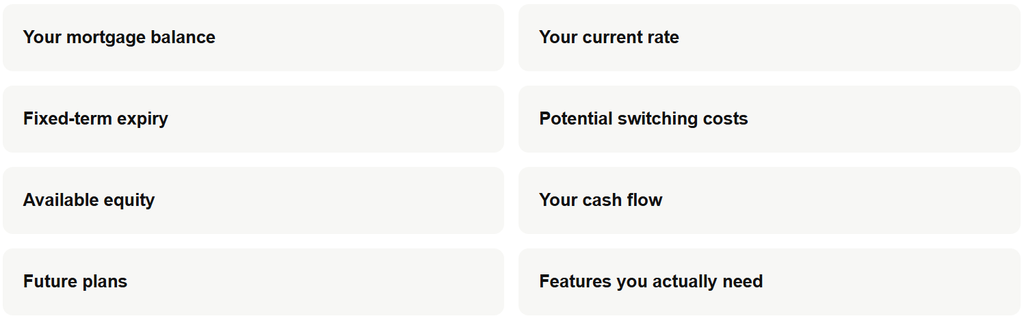
Instead, focus on the factors you can actually evaluate:
The Simple Refinancing Timing Test
Ask yourself five questions:
- Is my fixed rate approaching expiry?
- Have market rates changed significantly since I arranged my lending?
- Has my income, debt or equity position changed?
- Does my existing mortgage structure still suit me?
- Do I have a major financial or property goal coming up?
If one or more answers are yes, that does not automatically mean you should refinance. It may simply mean it is a sensible time to review your mortgage and compare your options.
Frequently Asked Questions
Should I refinance as soon as mortgage rates fall?
Not necessarily. A lower market rate is only one consideration. Existing fixed terms, break costs, fees, cashback conditions and your individual circumstances should also be considered.
Should I wait until my fixed mortgage rate expires?
You do not necessarily have to wait until expiry to start reviewing your options. Looking earlier can give you time to compare possibilities and understand any costs associated with changing your lending.
Can I refinance if I recently bought my home?
Potentially, although there may be costs or conditions associated with leaving your existing lender. A new application would also need to satisfy the new lender’s criteria.
Is refinancing worthwhile if my mortgage balance is small?
It depends on the potential benefit compared with the cost of refinancing. With a smaller remaining balance, switching costs can have a greater impact on whether a change is worthwhile.
Can I refinance when buying an investment property?
Potentially. Existing homeowners sometimes review their lending when considering another property, particularly when investigating available equity. Any new lending remains subject to lender criteria and affordability requirements.
Does having more equity make refinancing easier?
Equity can influence the options available, but it is not the only consideration. Income, expenses, existing commitments, credit history and serviceability may also form part of a lender’s assessment.
Related Mortgage Guides
Should You Refinance Your Mortgage?
What Happens When Your Fixed Mortgage Rate Expires?
How to Choose the Right Mortgage Structure
Fixed vs Variable Mortgage Rates: Pros, Cons and When Each Makes Sense
How Long Should You Fix Your Mortgage For?
Is Now the Right Time to Review Your Mortgage?
If your fixed rate is ending, your circumstances have changed or you simply want to understand whether your existing mortgage still suits you, Mortgage Advisors can help you review your options.

